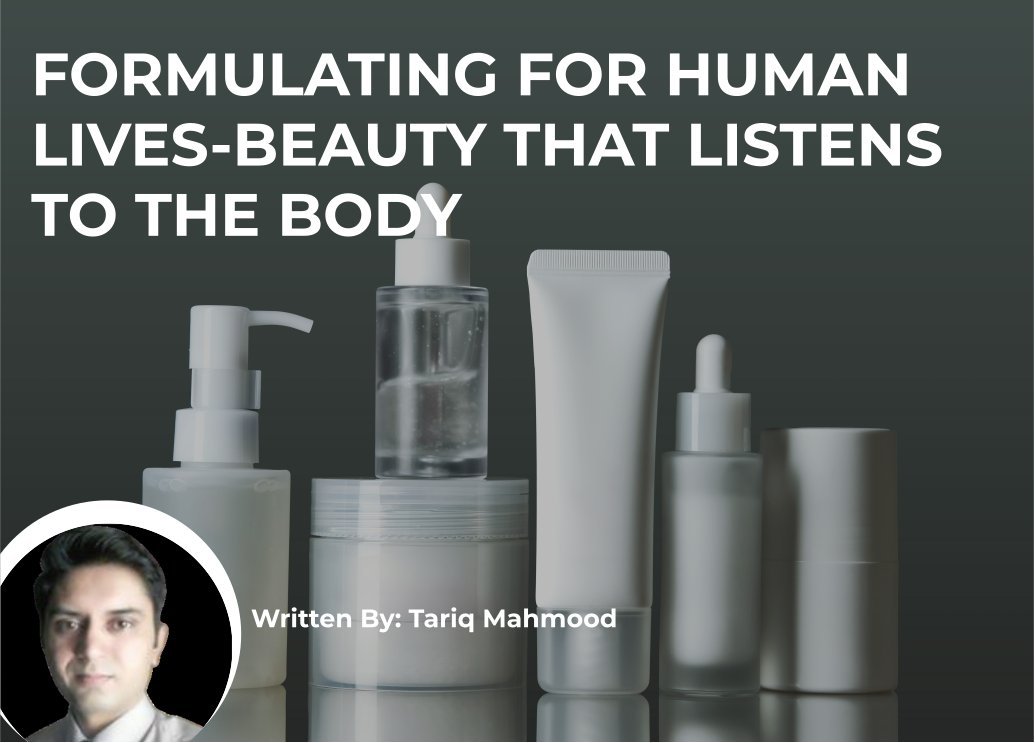
In today’s beauty landscape, we are witnessing a paradigmatic shift — one not driven by surface trends or short-lived marketing, but by a profound reorientation toward human biology, lived experience, and genuine benefit.
As cosmetic scientists and formulators, we’ve long celebrated innovation for innovation’s sake. But the real frontier isn’t science divorced from humanity — it’s science that responds to human complexity, physiology, behavior, and long-term wellbeing.
This is the heart of formulating for human lives — a philosophy that places the biological human experience at the center of every design decision. It means asking questions that go beyond “what feels nice” or “what’s trending” and instead asking: How does this interact with real skin? Real behavior? Real health outcomes?
Biology First — Understand Before You Formulate
Traditional product development often begins with ingredients or claims. Formulating for human lives begins with biology — the living tissue we seek to influence.
The skin isn’t simply a canvas; it’s a dynamic organ with layered barriers, immune signaling, microbial ecosystems, and sensory nervous networks. Understanding how actives penetrate, interact, and support these living systems is not a nice-to-have — it’s fundamental to meaningful efficacy. This perspective mirrors scientific perspectives on transdermal systems and biological barriers studied in dermatological research.
By starting here, every formulation becomes more than a product — it becomes a bio-responsive interface between the molecule and the human.
Functional Delivery — Meet the Skin Where It Is
Human skin doesn’t absorb all ingredients equally. Some molecules struggle to reach the layers where they can make an impact; others degrade or irritate before they ever work. This is where delivery science — not just ingredient selection — transforms performance.
Techniques like encapsulation, nanocarriers, and targeted release have been central to recent advances in delivery systems. These technologies protect sensitive actives and enhance their penetration deeper into the skin or scalp, reflecting the core principle that how you deliver an ingredient is as important as what the ingredient is.
In the framework of human-centric formulation, delivery is intentional: aligned with physiology, responsive to skin state, and mindful of long-term tissue health.
Human Behavior — Real Use, Real Routines
One of the most overlooked aspects of formulation is how people actually use products. A formula may perform beautifully in a lab, but if it doesn’t fit into real routines — morning, night, rush-hour stress, or minimalist dressing tables — its effectiveness evaporates.
Formulating for humans requires empathy: understanding daily patterns, preferences, sensory experiences, and even cultural habits. This is why minimalist dosing formats, multi-functional products, and intuitive packaging increasingly matter — they align with real behavior, not just ideal lab conditions.
Safety, Sustainability, and Long-Term Impact
Human lives aren’t measured in quarters — they are long arcs of change and experience. Responsible formulation means evaluating safety beyond regulatory minimums and considering long-term effects on skin resilience, barrier integrity, and microbial harmony.
Simultaneously — and importantly — human-centric science embraces sustainability. Delivering benefit shouldn’t compromise environmental health. This echoes broader industry thinking that solutions must be future-proof, biologically safe, and planet-aligned — a lesson the delivery systems revolution has already begun to model.
Evidence Over Buzz — Claims That Matter
Marketing proliferation has trained consumers to expect bells and whistles. Yet human-first science rejects superficial claims in favor of measurable outcomes.
Rather than “anti-aging” as a fluff phrase, formulations should aim to support cellular integrity, preserve barrier function, and enhance resilience. Instead of “radiance,” the goal should be measurable hydration, improved texture, and skin health markers. The trend is shifting from narrative aesthetics to evidence-anchored results.
Integrative Systems — Beyond Products to Experiences
Human lives are complex. Skin is ecosystemic. Beauty isn’t isolated from lifestyle, stress, environment, or biology. That’s why the most meaningful innovations today aren’t just formulas in bottles — they are systems that integrate delivery, behavior, interaction, and biology.
Whether it’s a patch delivering actives where needed most, a microencapsulated formula that releases over time, or a hybrid product that responds to real-time skin conditions — systems thinking places the human at the center of design, not marketing.
Why This Matters
The next revolution in beauty will not be measured solely in SKUs, buzzwords, or Instagram aesthetics — it will be measured in human outcomes.
When we formulate for human lives, we stop chasing surface appeal and start engineering meaningful, biologically aligned, behaviorally informed, and sustainably sound solutions. This is the future of beauty — where science responds to life, not just looks.
Beauty, truly, becomes a lived experience, not a momentary marketing impression.
This article is written to explore practical, science-led thinking in formulation design—shifting the focus from trends and claims toward how formulations genuinely interact with human biology and lived experience. For CM Studio+, it reflects the evolving frontier of cosmetic science, where design decisions are informed by physiology, behavior, and long-term impact rather than surface appeal.
Tariq Mahmood, Ph.D., is a cosmeceutical scientist working at the intersection of formulation science, biological systems, and emerging computational tools. His work bridges classical cosmetic chemistry with forward-looking domains such as AI-assisted formulation intelligence, neuro-olfaction, and responsive delivery architectures. Through his writing and research, he translates complex laboratory science into human-centered narratives—ones that ask not just what a product is, but how and why it matters to the person using it.
For those interested in the next evolution of beauty—whether adaptive delivery systems, skin-brain communication pathways, or formulations designed to respond to real human conditions—Tariq actively engages with researchers, brands, and innovators who believe the future of formulation lies in collaboration, evidence, and respect for human biology.