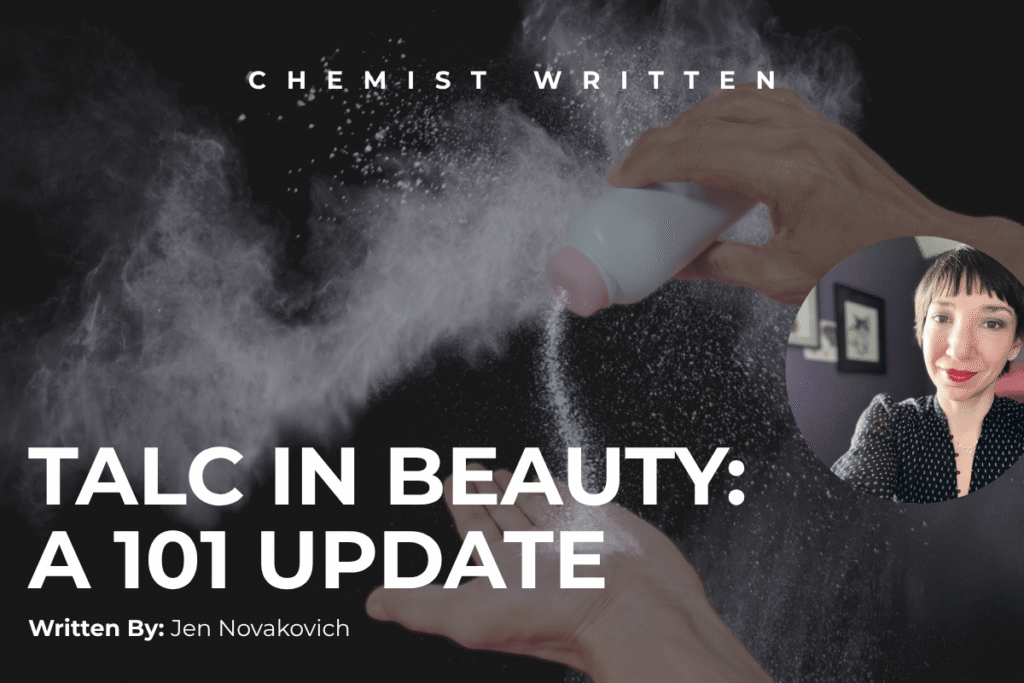
Unless you’ve been living under a rock, you’ve probably heard about how terrible talc is. Turns out, a lot of the fearful narratives don’t actually match the science. In this post, I’ll dig into the different layers of the topic that, as formulators’, I think are super important to understand. The insights in this post are based on an interview I did with toxicologist Lyle Burgoon PhD ATS. For loads more depth, that podcast is a must listen!
What is talc?
It’s a natural mineral that we get out of the ground via mining. It’s made up mainly of magnesium oxide (MgO) and silicon dioxide (SiO2). There are different grades of talc depending on their intended use, each with different stipulations for purity.
Functions: abrasive, absorbent, anticaking agent, bulking agent, opacifying agent, skin protectant, and slip modifier.
Talc has been used historically in a lot of different cosmetic products due to its unique properties that provide end performance outcomes that are extremely difficult to match, especially at a similar price for the end product. Talc is also chemically inert, which is a good thing in terms of stability and safety of finished products.
Uses for talc in cosmetics formulations?
Absorbs moisture – this is part of why it’s really useful for diaper rash. This also helps w/ the staying power of makeup, or in products like dry shampoo.
It can improve product feel, giving makeup a soft glide when applied.
It’s resistant to heat, which is really important in the manufacturing of products that need high heat to be made, like lipsticks.
It’s also an exceptionally good carrier for color additives. It helps improve things like color payoff, giving an even spread of the color without patchiness.
Compared to any of its alternatives that come close to having these performance attributes, talc is significantly more cost effective. If you’re wondering why talc-free products are more expensive, this is a big component of why.
Asbestos & Talc?
Geologically speaking, talc and asbestos are commonly found near each other in adjacent, but disparate, strata. With proper mining methods, asbestos contamination can be avoided. The quality of talc is controlled depending on its grade. With cosmetic grade talc, there are stringent requirements for purity to ensure finished cosmetic products are safe.
With the improvement of analytical tools, asbestos has been found in talc historically (e.g. Claire’s case)… but this is a huge complicated mess. E.g. with greater availability ➔ more labs testing, but not all the labs doing this have the right training to understand what they’re seeing. It’s actually really difficult, with the asbestos we’re concerned with easily confused with innocuous stuff. Improper testing protocol/quality control can also easily contaminate samples (e.g. asbestos is often in our environment) leading to false positive results, which has been a historical problem. This is why FDA has explicitly chosen 1 lab (AMA) to work with to do testing, because they have demonstrated expertise and track record specific to reputable talc testing.
Between 2020-2023, AMA Labs was tasked to do 3 separate market surveillance studies randomly testing talc-containing products on the market. Finding? Zero asbestos contamination found.
Due to the challenges of testing talc, you’ve probably heard a lot of noise that regulators are trying to sort out a standard. This is more a conversation for industry, which has been taken out of context by the media.The AMA testing results should give us confidence regarding the quality of the talc used on the market in personal care products these days.
What about the recent FDA Proposed Rule Withdrawal!?
There were recently a lot of headlines about the FDA withdrawing its proposed rule on cosmetic testing. It was disappointing to see many journalists obviously had a story they wanted to tell… Conveniently, the above testing results were left out of most of the commentary… Important: the reason this ruling was withdrawn was because it had gaping issues legally and scientifically that would have likely ended up with:
- a) big lawsuits directed towards FDA and brands
- b) no improvement in the safety of talc on the market, and
- c) a huge financial drain.
It would be one thing if the ruling would actually help, but for that to happen, regulations need to be well-designed and based on good science. Pseudoscientic testing standards don’t help anyone, and are more harmful than many seem to realize...
Ovarian Cancer & Talc?
When we properly weigh all the evidence we have, the overwhelming body of evidence does not support the idea that talc use causes ovarian cancer.
The proper weighting point is the important one here, and for any scientific topic. You can find studies to confirm just about anything. But how were they done? Were they statistically significant? Was there P-value hacking? How many participants? Was it a correlative or causal finding? Were the findings replicated by other researchers? And so on. Single studies ≠ strong evidence. To sort out where the evidence is for any given topic, we need to critically appraise all the studies that have been done. And put them all into context in terms of their weight (e.g. small case control studies aren’t as strong as massive prospective studies with 100k+ people).
Also important: class action lawsuits aren’t always aligned with the science. Jurors are generally not scientists. When there’s so much compelling noise out there, like any human, it’s easy for them to let their biases find their conclusions…
It’s also very human to try to find answers about why something bad happened to you… And so when consumer lawyers tell you they have the answer, especially with all the noise out there, it’s easy to be convinced… There is BIG money to be had for lawyers to do this kind of thing…
Should finished product consumers be worried about cosmetic products w/ talc?
Despite the noise, the body of scientific evidence overwhelmingly points to safety for talc in cosmetics on the market. There are ongoing conversations in industry about standards for testing, but this is more a conversation that the industry needs to be watching, rather than final consumers. For formulators, working with reputable suppliers and doing your due diligence for quality and safety assurance as products are brought onto the market is very important.
Worth knowing: the adverse health outcomes related to asbestos require a certain exposure for an adequate amount of time. Yes, asbestos is well known to cause mesothelioma. Based on everything we know about exposure/risk profiles, this outcome is relevant to industrial worker scenarios. Even for folks who are renovating an old house with asbestos, this exposure level x time would be unlikely to cause mesothelioma.
Also worth knowing: asbestos is ubiquitous in the environment. Like it or not, we’ll all be exposed… But these exposures are generally fine in terms of health outcomes. The statement that there is “no safe level of asbestos” is pseudoscientific. Like anything else, dose/exposure makes the poison.
A big challenge in this discussion is that there has been a complete lack of adequate risk and science communication to the public to help us understand the context. And so, with all the fear, uncertainty, and noise, misinformation was ripe to fill the gaps
What we just covered is just the tip of the iceberg of the talc conversation, but gives you an overview of the important controversies around talc right now. For loads more important context, you’ll want to listen to the podcast episode with Lyle Burgoon PhD ATS that’s associated with this blog. Find the episode here: https://www.theecowell.com/podcast/talc101