There is a very specific kind of joy in cosmetic formulation that almost never makes it into a marketing brief.
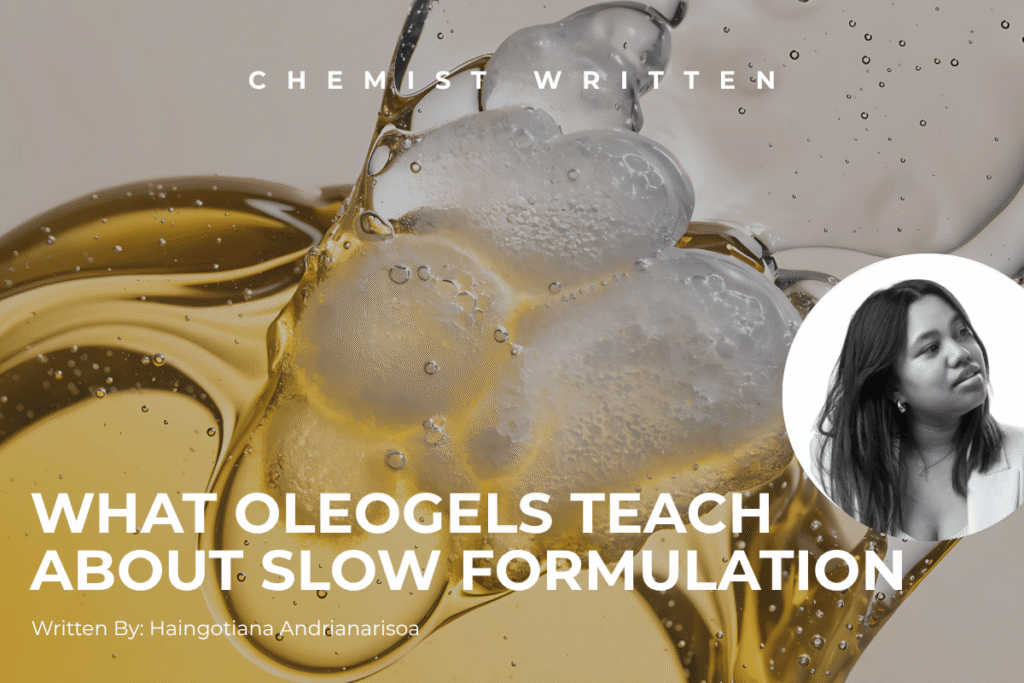
It is not the joy of hitting a viscosity spec or nailing an INCI list that ticks every clean-beauty box. It is the joy of watching an oleogel come together – that moment when a pool of liquid oil, with nothing but a pinch of wax or a whisper of an oleogelator, quietly turns into something you can scoop, spread, and hold upside down without a drop moving.
If you have not formulated an oleogel, I want to convince you to try. And if you have, I suspect you already know exactly the feeling I am describing.
An Underrated Texture
Oleogels sit in a strange, under-loved corner of our toolbox.
We talk endlessly about emulsions, about HLB values and phase inversion temperatures, about the eternal chase for “melt-in” sensoriality. But oleogels – 100% oil-phase systems, structured into a semi-solid network by waxes, fatty alcohols, or oleogelators like hydrogenated castor oil, candelilla wax, rice bran wax, or sorbitan esters – barely get a mention outside of balm and cleansing balm formats.
That is a shame, because the texture they deliver is genuinely special.
Silicone-free slip. A cushiony, almost velvet set. The ability to carry high concentrations of actives in an anhydrous, preservative-light environment. And visually, when done right, an oleogel is beautiful – glossy, dense, opaque or translucent depending on your gelling agent, with a mouthfeel, or should I say skinfeel, that emulsions simply cannot replicate.
So why do we not see more of them?
Partly formulation inertia – emulsions are the default mental model most of us are trained in. Partly market education – consumers, and even some brand teams, do not always know how to “read” an anhydrous texture the way they read a cream. And partly, honestly, because oleogels have a reputation for being finicky.
That reputation is deserved, but for reasons that have very little to do with the chemistry.
The Real Challenge Is Not the Formula. It Is the Hands.
Here is the thing nobody tells you in textbooks: the INCI list for a stable oleogel is often shockingly short.
One gelling agent, one or two emollients, maybe an antioxidant. If you are building toward an emulsion afterward – a gel-in-water, a whipped oleogel cream – you will need proper stabilizers to bridge the oil-structuring network with your water phase, and that is its own art. But for the oleogel itself, the formula is rarely the hard part.
The hard part is the process.
Oleogels are made, not just mixed.
You melt your structurant, and then slowly, patiently, almost meditatively, you pour your liquid oil in as it cools, in small aliquots, while continuously turning the mass.
Not whisking. Not homogenizing at 3000 rpm because you are behind schedule.
Turning. Folding. Coaxing the oil into the crystallizing network as it forms, so the wax matrix has time to trap and hold each addition before you give it more.
Pour too much oil at once, or pour too fast, or let your temperature drop out of window, and the network cannot keep up. The oil separates out instead of being captured. You get graininess, oil weeping, a surface sheen that tells you instantly, without a rheometer, that something went wrong three steps ago.
There is no fixing it after the fact.
You start again.
And that is precisely what makes it satisfying. There is no shortcut, no clever excipient that lets you skip the attention. The stability of an oleogel is a direct, physical record of how carefully you worked.
When it sets clean – dense, glossy, structurally sound, no bleed – it feels less like a QC pass and more like a small craft accomplishment. It is the same quiet satisfaction a chocolatier gets from a perfect temper, or a baker from laminated dough that did not tear.
A Few Things That Have Saved Me Over the Years
Aliquot, always.
Add your oil phase in small, controlled additions – never as one pour – especially as you approach your gelling agent’s crystallization onset.
Watch temperature, not the clock.
The “right” moment to add the next aliquot is dictated by viscosity and crystallization behavior, not by a fixed timer. Every batch, every ambient temperature, will ask for slightly different pacing.
Turn, do not shear.
High shear disrupts the crystal network as it is forming. Gentle, consistent folding gives the structurant a chance to organize around the oil rather than fight it.
Scale changes everything.
A process that works beautifully in a 200 g beaker can behave completely differently in a 20 kg vessel, purely because cooling rate and pour rate scale differently. Do not assume linear scale-up. Re-map your addition schedule at each batch size.
Let it rest.
Many oleogels continue building network strength for hours, sometimes days, after pouring. Judge stability on cured samples, not the fresh pour.
Final Thoughts
If you have never stood over a beaker, turning a warm oleogel by hand and watching it go from glassy liquid to something with body and hold, I really do recommend it.
It is one of the few moments in this job where the process itself – not just the outcome – is the reward.